
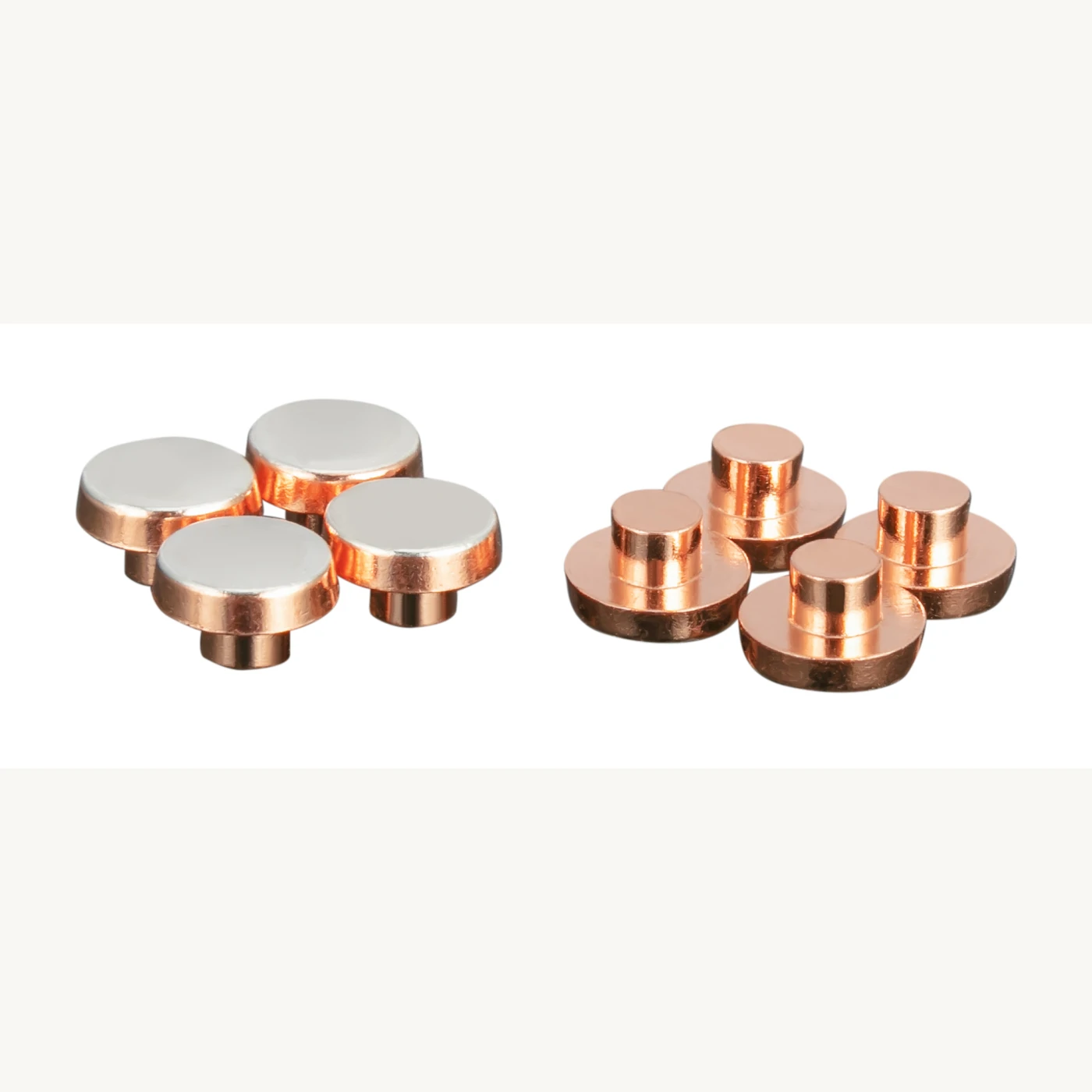
Choose the production route according to the alloy system
For some systems, melting and alloying, and for others, powder metallurgy or internal oxidation is more suitable. Each path should create a uniform distribution of components, density and required properties of the final part.
The name of the process should not replace the admission specification; Composition, microstructure and properties should be evaluated based on the application and the agreed document.
Convert alloy blanks to part form
After preparation, the wire, strip, profile or preform becomes a rivet, contact tip or flat piece. Cold forming, pressing, cutting and machining can be used at this stage.
Cracks, pleats, asymmetric deformation and surface damage are signs that should be checked in the prototype and control during the process.
Control the interface in composite structures
In a bimetallic or trimetallic rivet, the bond between the functional alloy and the base metal must be stable against forming and assembly. The thickness of the layer, the continuity of the connection and the location of the working alloy are among the key characteristics.
Selected cross-sectional inspection and mechanical testing can reveal joint weakness or layer displacement prior to series production.
Define the method of connecting the part to the carrier
Riveting, resistance welding, spot welding, induction soldering and other joining methods each require different geometry, carrier alloy, flow path and thermal limitation.
Contact surface quality alone is not enough; The strength and stability of the connection area should also be controlled in the complete assembly.
Close the process with a representative example
The sample should represent both the dimensions and appearance as well as the function of assembly and switching. Any change in alloy, tooling, thickness, or connection method may require reconfirmation.
Practical summary
Any alloy, geometry, or corrective action decisions must be verified by controlled drawing and representative testing on the final assembly.
Submit a technical issue